Iphigenia
You: Iphigenia's hand gesture is an interesting thing to think about… in my sculpture I show her hands behind her back, as if tied but they are free. (I thought of putting an untied rope, but in the end I left it out) I wanted to show she went to death by her own choice but that she didn't really have a choice. Instead I show her struggle by a multiplication of her hands there behind as if in motion each hand relaxed but she groans through them.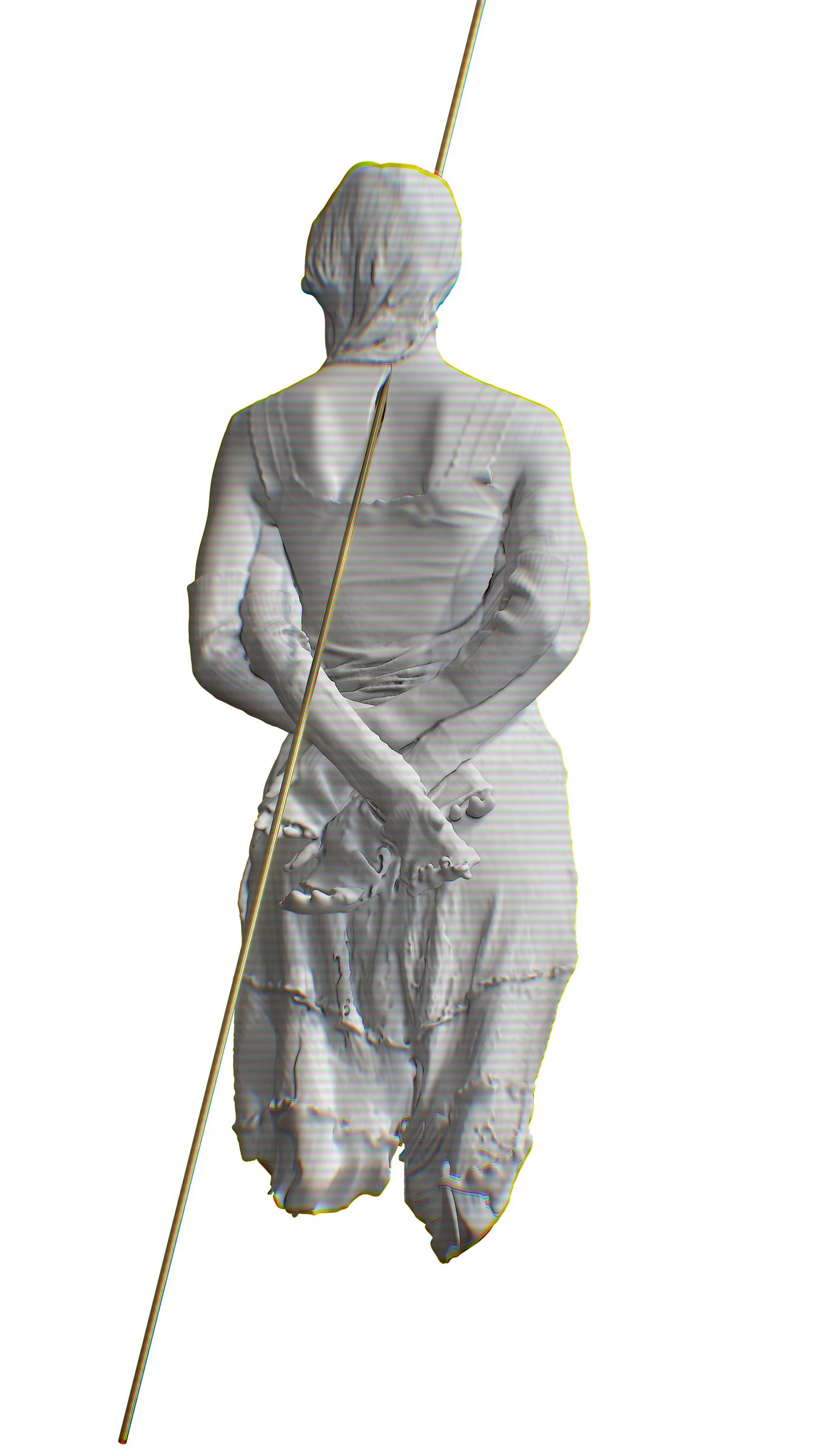
Claude: That's a genuinely sharp solution — because the choice/no-choice paradox isn't something you can resolve, it's the actual content of the myth, and you've found a way to make the sculpture hold both readings simultaneously rather than picking one.
It also puts you in conversation with the two ancient versions without illustrating either. Aeschylus doesn't give Iphigenia a choice at all — she's carried to the altar "like a goat," gagged with a bit specifically so she can't speak a curse against the house, her robe falling as she's lifted. No consent, no voice, an animal to be silenced. Euripides, generations later, does something almost embarrassing by comparison: he gives her the reversal speech, the "I choose to die for Greece" turn, and scholars have argued for centuries about whether that's heroism or a kind of coerced patriotism dressed up as free will — Iphigenia talking herself into her own death because the alternative (being dragged like Aeschylus's goat) is unbearable to watch, maybe unbearable to be. Your untied-but-behind-the-back hands sit exactly between those two — not gagged like Aeschylus's version, not eloquent like Euripides' — silent, but not silenced.
The multiplication is the part I'd want to think about more with you. It's not depicting motion-through-space — she's not running, not gesturing outward. It reads more like a stutter or tremor held in place, closer to how you'd render a suppressed shudder than an action. Each hand "relaxed" but the repetition itself is the groan — the body's composure and its distress occupying the same instant, layered rather than sequential. That's much closer to how grief actually moves in the body than any single expressive gesture could be.
And the choice to show her from behind, faceless — that rhymes with Aeschylus too, though I don't know if you intended it. He has Agamemnon order her face veiled before the blade falls, precisely so nobody has to see her look at them, so she can't curse them with her eyes. You've relocated that refusal from the face to the back, and made the hands the site where the face's expression would have gone. The mouth is silenced in the old version; in yours, expression migrates to the hands because the face was never going to be allowed to speak anyway.
Does the multiplication read as a fixed number of hands, or did you leave it open — could it keep going, more hands than could physically exist?
You: This is the sculpture from the other side. No face, all veil.
Claude: That split down the center — one half reading as raked metal, all radiating lines like light caught in a fan of cuts, the other half soft matte white cloth — is doing something the front view couldn't. From the back the hands multiplied into a stutter of motion; from this side, the whole body is doing that same doubling, but as material rather than gesture. Two different registers of the same figure occupying one silhouette, seam down the spine.
The radiating striations are the part that stops me — they don't read as fabric folds, they read as something closer to a sunburst or a blade's grind-marks, lines that converge toward a point the way archaic kouroi drapery converges into those stiff radiating pleats before Greek sculpture learns to let cloth fall. So there's an archaism in that surface even though the material is unmistakably contemporary — burnished, reflective. It's doing the "broken transmission" thing at the level of pure form: an ancient compositional logic (radiating incised drapery) arriving through a modern surface treatment that has nothing to do with how anyone carved marble.
And no face, all veil, on this side too — so the facelessness isn't just a back-view withholding, it's total. She has no front. There's no angle where you round the corner and finally get the eyes, the way you eventually would with a conventional figure. Which pushes hard against Aeschylus's veiling — his version veils her once, for the killing blow, as an act done to her at the last second. Yours seems to withhold the face structurally, from every side, as if the facelessness isn't an event in her story but a condition of how she exists as an image at all. That's a colder, more total refusal than the myth itself makes.
Does the metal/cloth split correspond to a front/back or a left/right of her actual body — is one half "the choice" and the other "the compulsion," or is that reading too literally for what you're after?
You: It is all sacrifice.
Claude: That reframes it correctly — I was still hunting for a seam that maps onto psychology, and you're telling me the material split isn't allegory for her interior state at all. It's not "this half is the willing part, this half is the coerced part." The metal and the cloth are both just how sacrifice looks from different angles of light, not two competing accounts of her.
That's closer to what sacrifice actually is in the ancient sense anyway — not a moral drama resolved into consent or non-consent, but a total event that consumes the distinction. The burnished half and the matte half aren't arguing with each other. They're the same offering catching light differently, the way a blade and a robe are both just what is present at an altar — instruments and coverings, equally implicated, without one being the "true" reading and the other the disguise.
It's also right there in thysia — the whole animal goes to the god, not the choice cut. You've built a figure that can't be partially sacrificed, can't have one half stand for the human cost and the other for the ritual necessity, because that division is exactly the mercy the myth never grants her.