METOPE — Paint and Glaze
How colour and glaze land on a stroke in METOPE, and how the four dials that govern it interact. Every number here was measured out of the running app on a 500 × 500 × 200 mm block, not estimated.
Revised 2026-07-27, when three of the four changed.
Contents
What was wrong
Colour opacity used to be wired to carve depth — the Height (mm) slider — and each dab composited softly over the last. A soft dab's rim contributes almost nothing, so opacity could only accumulate where dabs piled on top of each other: along the centreline. A stroke painted a thin stripe up the middle of a mark three times wider, and Stamp laid no colour at all.
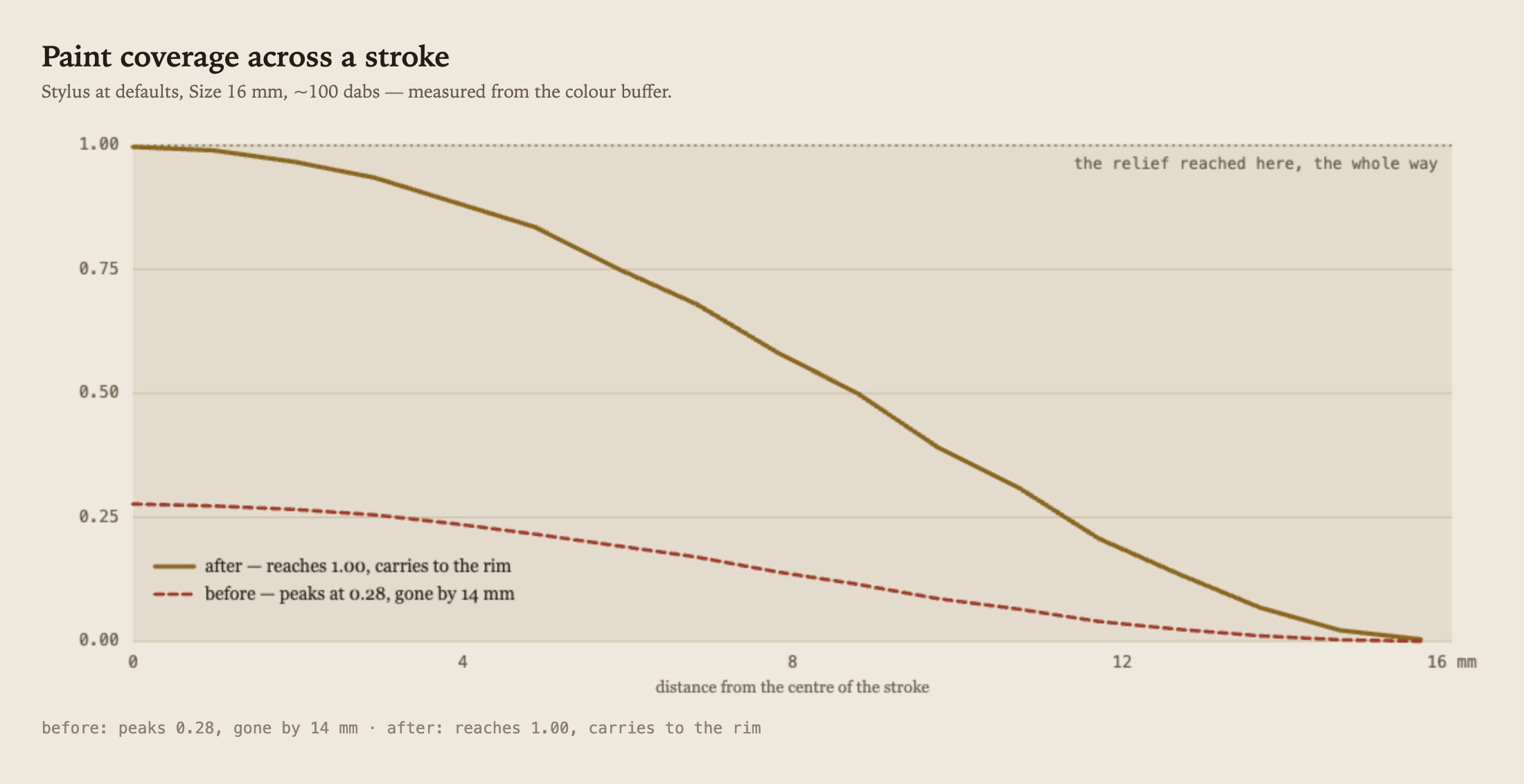
The relief covered the full width the whole time. Only the paint fell short.
Coverage
How solidly a mark covers its own footprint. 1.00 is opaque across the full width of the brush, or the full silhouette of a Stamp or Imprint. Lower it for a wash. It has nothing to do with Height (mm) any more.
The important property: a single stroke lays one consistent film. Set Coverage 0.40, scribble a stroke that crosses itself ten times, and every part of it — crossings included — reads exactly 0.400. Lift the pen and stroke again and it builds properly: 0.40 over 0.40 gives 0.640. Transparent glazes are possible for the first time.
Softness (edge)
Where the mark stops. Below 0.50 it hardens toward a crisp disc, for clean colour blocking. 0.50 is the classic feathered dab. Above 0.50 — which used to do nothing at all to paint — the fade now runs past the Size radius.
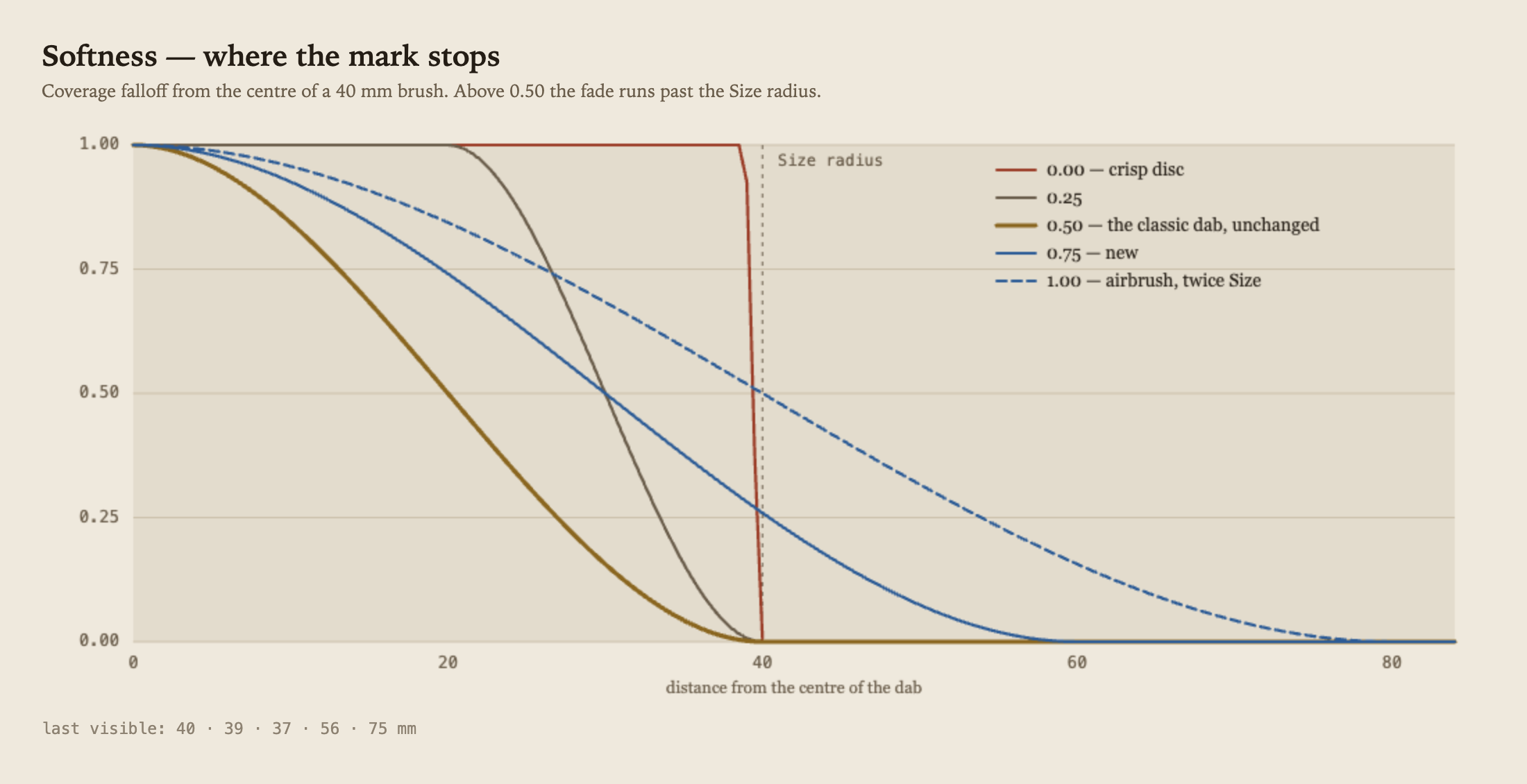
At 1.00 the mark reaches roughly twice Size with no boundary — an airbrushed halo. Below 0.50 it never exceeds Size, so the brush ring is the true extent; above 0.50 the soft tail deliberately overruns the ring.
Softness lands in three places at once: the shoulders of the sculpt, the edge of the paint, and the feather on a Stamp or Imprint silhouette. Change it for one and you have changed all three.
Flow ↔ Flat
How much the glaze reads the relief. At 1.00 it pools in hollows and thins on ridges; at 0.00 it ignores the relief entirely and lays an even coat at full strength. ALT flips the pooling to catch the ridges instead — a drybrush highlight.
Glaze strength as a fraction of your Coverage:
| in a hollow | flat ground | on a ridge | |
|---|---|---|---|
| Flow 1.00 | 1.00 | 0.50 | 0.17 |
| Flow 0.50 | 1.00 | 0.75 | 0.59 |
| Flow 0.00 | 1.00 | 1.00 | 1.00 |
Flat ground sits exactly midway between hollow and ridge, so at Flow 1.00 an untouched flat area takes half your Coverage. That is the design, not a weakness. If a glaze looks weaker than the Coverage you set, this is why — raise Coverage to compensate, or pull Flow down for a solid even coat.
Pool scale
How big a feature counts as a recess. The wash measures each point against its neighbourhood, and this is the radius of that neighbourhood. It used to be fixed at about 1.5 mm, which meant Flow could only ever see fine tool marks — anything wider than 8 mm read as flat clay however deep it was, so "pools in the relief" visibly didn't.
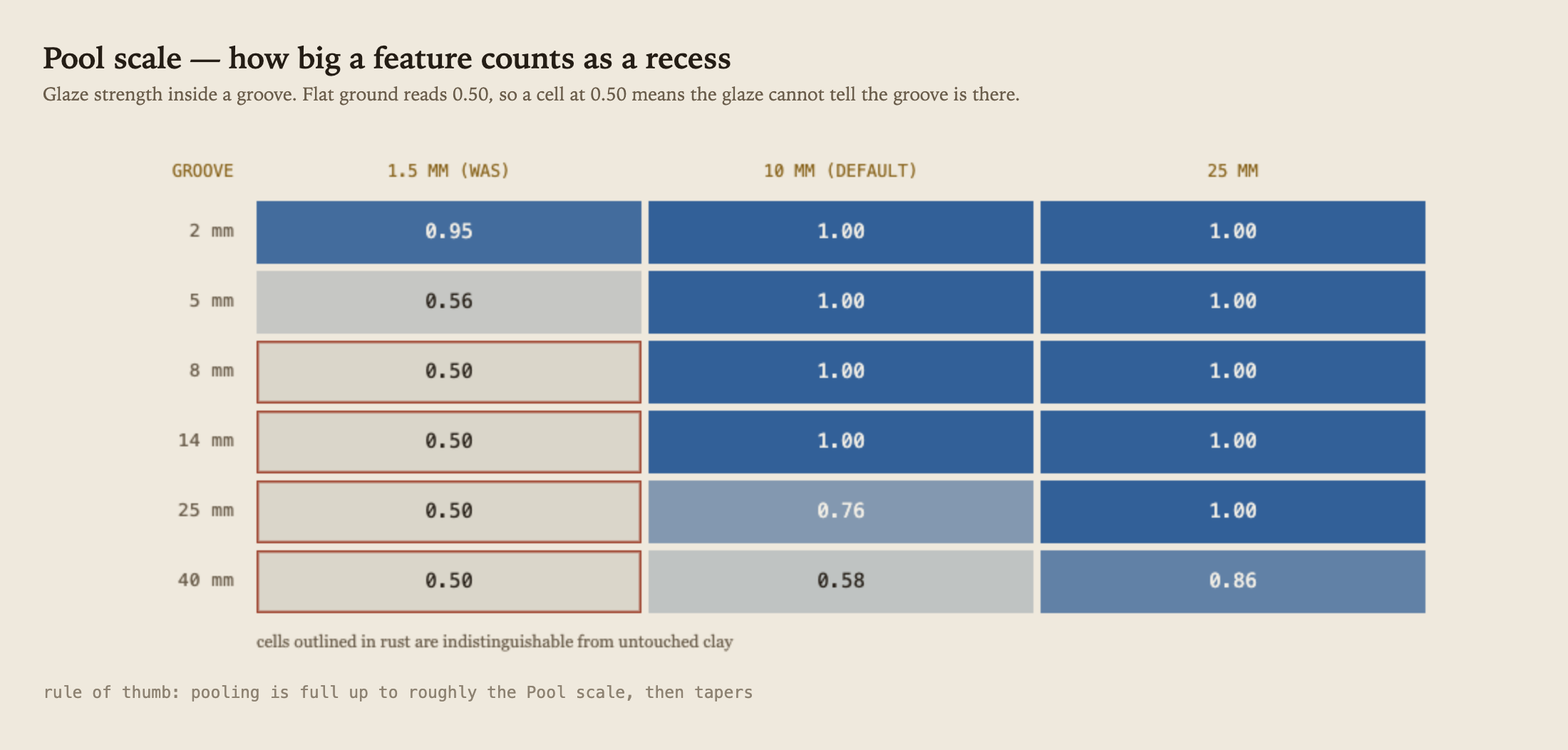
Rule of thumb: pooling is full up to roughly the Pool scale, then tapers above it. If a broad scooped form glazes flat, raise Pool scale past its width.
The coupling that catches everyone out
A crisp carve pools less than a soft one — the opposite of the intuition that sharper carving gives the glaze more to catch.
Identical 5 mm groove, 8 mm deep, glazed identically; only the Softness it was carved at differs:
| carved at | glaze in the groove |
|---|---|
| Softness 0.0 — crisp walls | 0.513 |
| Softness 0.5 | 0.565 |
| Softness 1.0 — rounded walls | 0.698 |
A hard-edged groove has a flat floor, and the middle of a flat floor is flat ground no matter how deep it is. A soft groove curves continuously, so every point on it sits below its own neighbourhood. Raising Pool scale past the groove's width fixes it — the walls alone become enough to register.
Starting points
Transparent glaze over carved detail — Coverage 0.25–0.40 · Flow 1.00 · Pool scale 10 mm · Softness 0.50. Stroke freely; crossing yourself will not darken it. Build depth by lifting the pen between passes.
Solid colour blocking — Coverage 1.00 · Flow 0.00 · Softness 0.00–0.15. Flow at 0 keeps the relief from modulating the colour, so a shape reads as one flat field.
Glaze that sinks into a broad hollow — Coverage 1.00 · Flow 1.00 · Pool scale 25–40 mm. For scooped, sweeping forms.
Airbrushed atmospheric wash — Coverage 0.15 · Softness 0.90–1.00 · Flow 0.30. The new top half of the Softness slider: no boundary at all, good for smoke, bloom and fired-edge effects.
The controls live in the ◐ Material tablet. Coverage sits at the top, above Roughness; Pool scale sits under Flow ↔ Flat.