INTERPRETE
INTERPRETE (Italian, "interpreter": the person who stands between two speakers and carries what is said across) is a phone app for following spoken Italian and learning it. It listens through the microphone and writes a running transcript, the Italian in a serif face with the English under it. What you say in English comes out in Italian instead, so the Italian is always the line to learn. Tap a word for its dictionary entry and, for a verb, the tense it is in and its whole conjugation. Keep a line, with the recording of how it was said, and it goes into the Quaderno (Italian, "notebook") to be reviewed on a spaced schedule.
It is one web page, added to the iPhone's Home Screen from Safari, where it opens like an app. Begun 2026-10-22.
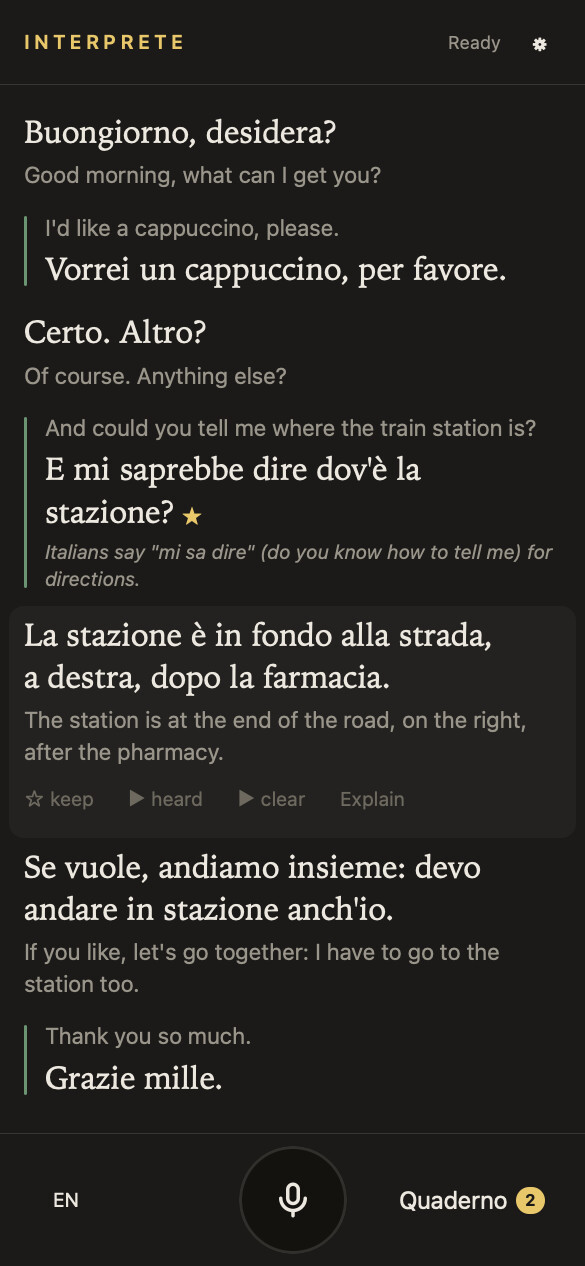
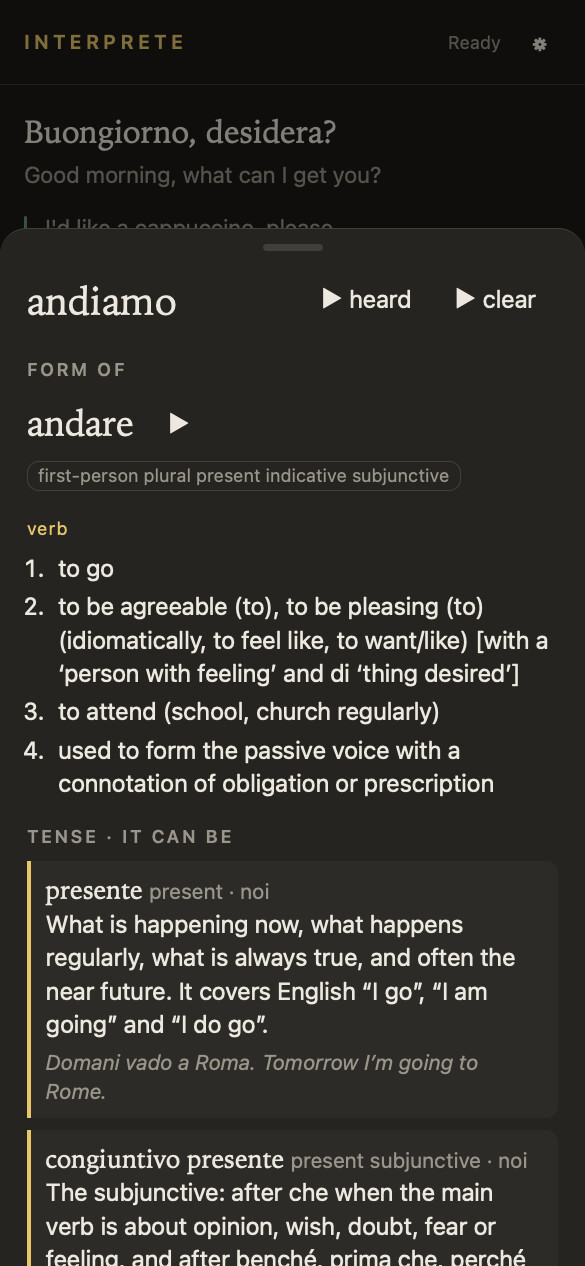
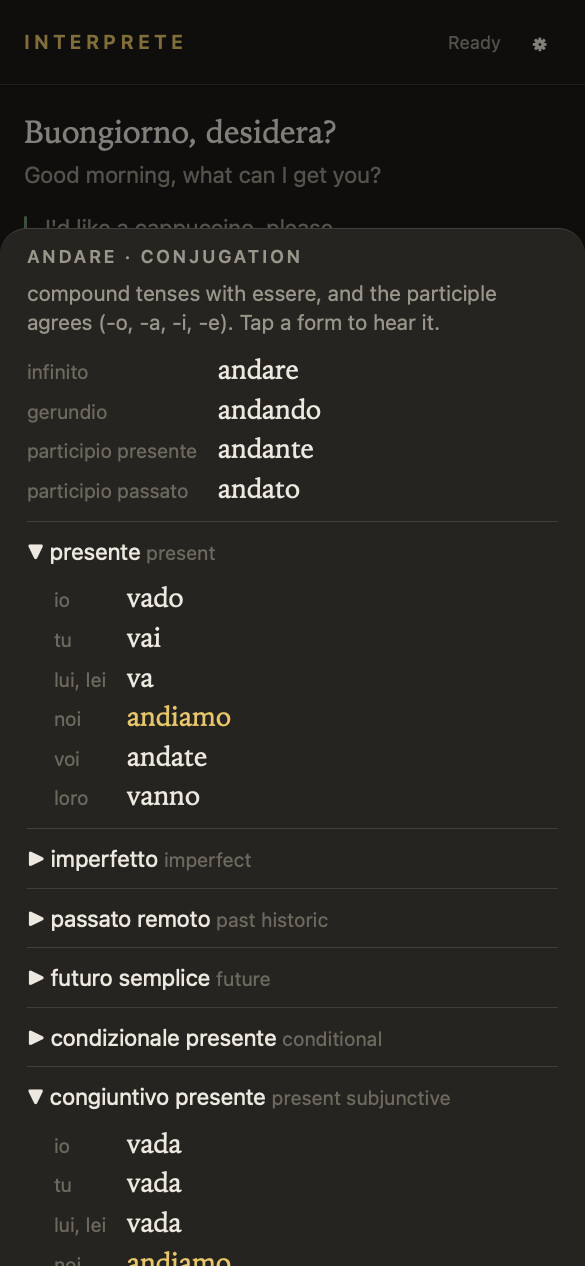
All the text in these pictures is sample text, not a recording: a made-up café exchange loaded into the app for the purpose. Left, the transcript with one line opened to show its buttons; the green rule marks what was said in English. Middle, a tap on "andiamo". Right, the conjugation of "andare", with the tapped form lit.
Contents
What you see
A header (the name, a status line, ⚙︎ for Settings), the transcript, and a footer with three buttons: EN on the left, the round microphone button in the middle, and Quaderno on the right, with the number of cards due for review. The ring round the microphone pulses with the sound it hears.
Each line has the Italian above in the serif face and the English below in grey. While someone is speaking, the words so far show in a paler grey and settle a moment later: in the October 2026 test, the first text came within a second and words settled about two seconds after they were spoken. A line closes at the end of a sentence, at a pause the listener detects, or at thirty words.
A line you said in English is drawn the other way round: what you said in small type, the Italian for it under in the serif face, and a green rule down its left edge. If there is something worth knowing about saying it (why Lei and not tu, a construction English speakers get wrong, a shorter everyday way), a short grey italic note stands under it; otherwise there is none.
Tap beside the words and the line opens its buttons: ☆ keep, ▶︎ heard, ▶︎ clear and Explain. ▶︎ heard plays the line as the speaker said it, from the recording of it; ▶︎ clear says it in the iPhone's Italian voice. A line you said has ☆ keep, ▶︎ say (the phone's Italian voice) and Explain.
The EN button cycles through five ways of showing the English, as training wheels: always; veiled, blurred until you tap it; shown after four seconds; hidden (IT only, which also stops translating while you listen and fills the English in later when you turn it back on); and EN only, which puts the English in the serif face in the Italian's place, a tap on a line showing its Italian.
Three ways of listening
Settings → Listening chooses how the sound becomes words.
- Streaming, the default: the sound goes up continuously to Soniox's real-time model, and the Italian and English come back as it is spoken.
- Word by word: Safari's own speech recognition (Apple dictation) writes the Italian as it is spoken, which Apple restarts about once a minute, and each finished line goes to Claude for its English. It keeps no recording, so it has no ▶︎ heard and nothing for Clean up to work on.
- On this phone only: the on-phone listener described under Offline.
Streaming and Word by word need a connection; without one, the on-phone listener takes over by itself. The pause that ends a line setting (0.5, 0.75 or 1.1 seconds) applies to Word by word and the on-phone listener; streaming cuts lines as described above.
Words
Tap a word and a sheet opens with the word, ▶︎ heard (that word in the speaker's own voice, cut from the line's recording when the times of its words are known) and ▶︎ clear. Under it, the dictionary form (andiamo is a form of andare, first-person plural, present indicative and subjunctive), the part of speech, the gender of a noun, and up to four meanings of each of up to three senses. The dictionary is Wiktionary's Italian entries (CC BY-SA, taken from the kaikki.org extract): about 150,000 entries and about 900,000 inflected forms, kept as one file per initial letter.
A verb gets more. First the tense the word is in: every tense it could be (andiamo is the present, the present subjunctive and the imperative, noi), each with a line on what that tense is for and an example. A past participle after a form of avere or essere in the line is named as the compound tense it makes (sono andata is the passato prossimo, io). Then the whole conjugation: infinitive, gerund, both participles, eight simple and seven compound tenses and moods, with the tapped tense open and the form lit; tap any form to hear it. The tables cover nearly 8,000 verbs. A word the dictionary lacks is sent to the on-phone translator; if that is not running, the answer is a dash.
Italian and English, both ways
By default one stream goes both ways. Soniox, a speech-recognition service, hears Italian and English on the same connection and translates each into the other. Settings → Languages switches to Italian → English only, which suits a lecture that quotes English.
The Italian for what you say is Claude's. Soniox's own Italian appears at once, in grey, as a draft; about three seconds after the line closes, Claude's takes its place. Claude is given the last few lines of the conversation and asked for what a native speaker would say in your place (Lei with strangers, tu with friends), keeping everything you said and adding nothing, with a note only when it helps. This is because Soniox's Italian is literal and blind to context: in a test it turned a lone "Please." into "Prego." If Claude cannot be reached, the draft stays grey and is filled in when the connection is back.
Streaming is the only mode that goes both ways. The other two listeners, Word by word and On this phone only, translate Italian → English only.
The Quaderno
☆ keep saves the line to the Quaderno with its recording, when it has one (a line you said in English keeps none). The Quaderno lists the kept lines, each with ▶︎ to hear it, ? for Explain and ✕ to drop it. Review takes the cards that are due: it plays the recording first (listen, then show the Italian, then the English). Again, Hard, Good or Easy then schedules the card, each button labelled with when it will come back (a new card: 10 minutes, 1 day, 1 day, 4 days). The scheduling is a simplified SM-2. A card for a line you said in English turns round: the English asks, "How would you say this in Italian? Say it aloud, then look," and the Italian, with its note, is revealed and spoken.
Explain
Explain asks Claude about a line, from the line's buttons or from the Quaderno. For something heard it returns the line as it was most likely said (which corrects mishearings), the English naturally and word for word, one to four notes on what is worth understanding (tenses and moods, clitic pronouns, idioms, regional or colloquial use, false friends), and up to five words to learn. For a line you said in English it returns how a native speaker would say it, what you said, the Italian turned back into English word for word, notes for saying it yourself next time, and words. Kept lines keep their explanation. It needs a connection.
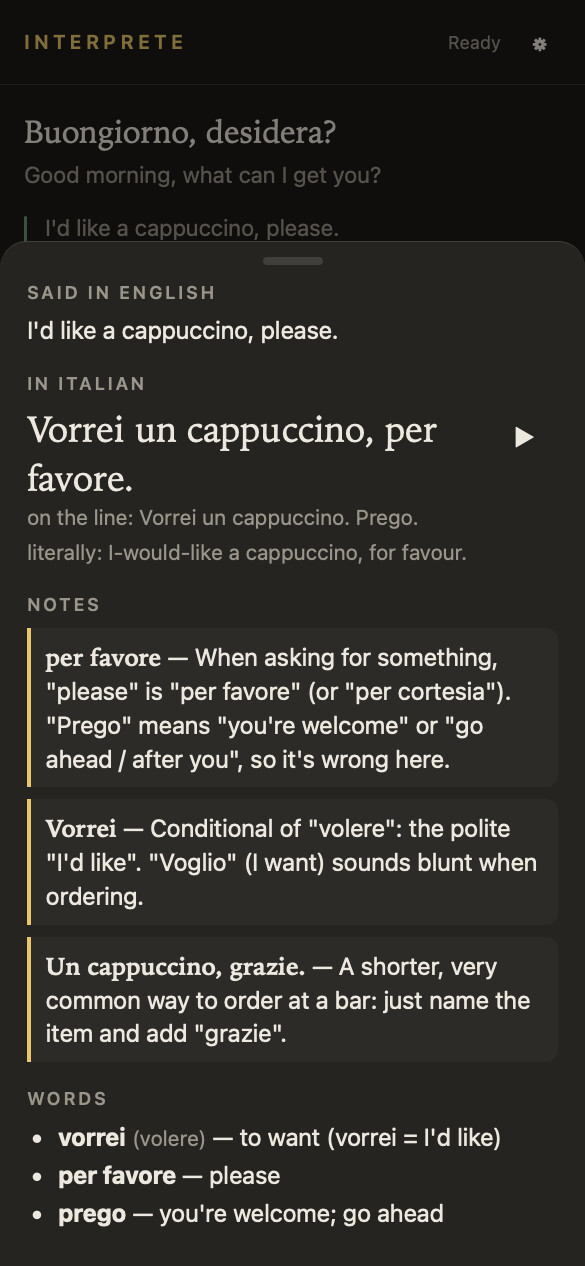
Explain on a line said in English (sample text). The wording of Claude's answer is the one recorded in the project's own test of 2026-10-30; it was loaded for this picture rather than asked for again. In that test Soniox's first Italian had come out as "Vorrei un cappuccino. Prego."
Clean up
A live transcript is a rough draft: it hears from a distance and does not yet know what the talk is about. Every streaming or on-phone session is also recorded whole on the phone (about 15 MB an hour), and Settings → Clean up today's transcript sends that recording to Soniox's batch model, which listens to all of it at once, knowing the key terms, and tells the speakers apart. The corrected transcript replaces that session's live lines, each speaker's lines headed Speaker 1, Speaker 2 and so on, and English follows; what was said in English goes to Claude for its Italian. A cleaned line that shares fewer than 15% of its words with what was heard live is marked "? heard live as: …", with the live text shown above it, since a listener can write fluent Italian out of noise.
Settings → Recordings… lists every recorded session with Listen, Save (the audio as an .m4a, through the share sheet), Clean up and Delete. Key terms takes names and words the talk will use; the listener is told to expect them, and names it hears are added by themselves. Save today's and Save everything build a timed text file (Italian with the English under it, ★ for kept lines, speakers if cleaned up) and open the share sheet.
What it needs, and what it costs
No key is in the page. The phone asks auriea.art for a Soniox key that lasts five minutes, and sends Claude's requests through the same server, which adds the real key. Prices are those quoted in the project's notes in October 2026; they are not re-measured.
| piece | needs | costs |
|---|---|---|
| Streaming (Soniox) | a connection | about $0.18 an hour, translation included |
| Italian for what you say, Explain, English that never arrived (Claude) | a connection | billed by Anthropic per request; no hourly figure for streaming. The older Word by word mode, which sent every line to Claude, measured about $0.50 an hour |
| Clean up (Soniox, batch) | a connection | about $0.10 an hour of recording, speakers included |
| On this phone only (Whisper and Opus-MT) | the models saved on the phone, once | nothing |
| Dictionary, conjugations, Quaderno, Review, voices | nothing after first use | nothing |
What leaves the phone
- While streaming, the microphone's sound goes straight to Soniox over its own connection, not through auriea.art, together with your key terms and a one-line description of the setting.
- The text of a line goes to Claude, through the server, when it is a line you said in English, a line with no English yet, or an Explain (in Word by word mode, every line).
- For Clean up, the whole recording is uploaded to a temporary file on the server under a random name, which Soniox fetches; the file and Soniox's copy are deleted when the job ends, and a file left behind is removed after two hours, at the next upload.
- Apart from its own files, the page requests nothing else: no outside scripts or fonts, no analytics, no account, no sync.
The transcript, the kept lines, the recordings and each line's clip live in the browser's own storage on that phone (the last 300 lines are shown at launch). Clear the transcript deletes the lines and recordings; kept lines stay in the Quaderno. Apart from that temporary file, there is no copy on a server, and no way to see them from another device. To take a transcript or a recording off the phone you tap Save, which opens the share sheet.
Offline
With no connection, the microphone starts the on-phone listener by itself: Whisper small (OpenAI's speech model) writes the Italian and Opus-MT (Helsinki-NLP's translation model) the English, both running on the phone's processor. Their files, about 465 MB, are fetched in the background once the app has started; Settings says "saved on this phone" when they are in. It is slower than streaming and goes Italian → English only. Safari's graphics-chip path never finished building the model on the iPhone, so it is not used there.
Offline you can also open the Quaderno and Review, play ▶︎ heard and ▶︎ clear, and look up words, but only in dictionary letters opened before: each letter's file is kept when it is first read. Streaming, English → Italian, Explain and Clean up need a connection. If the signal drops during streaming, the connection retries by itself, and if it cannot be restored the same microphone carries on with the on-phone listener; lines left without English are translated by Claude when the connection returns.
What it is not
It is not a recording or sharing app: it records each session so that lines can be replayed and cleaned up, keeps the recording on the phone, and publishes nothing. It is not an interpreter that speaks: it never says the English aloud, only the Italian. It does Italian and English, no other pair. It is not accurate everywhere: far-away speakers, echo and names are where it goes wrong, Soniox's English is plainer than Claude's, and the on-phone translator is weaker still (in one test it turned "cornetto", a pastry, into "crotch"). Stock phrases a listener invents from noise ("sottotitoli", "iscriviti al canale") are dropped, and a word repeated four times or more in a row is cut to three. Explain and the dictionary are there for the rest. It has been run on one phone, an iPhone 15 Pro Max.
Where it stands, 2026-11-19
Live at https://auriea.art/interprete/. The page and its scripts there are byte-for-byte the ones in TROY (checked 2026-11-19); the last build is dated 2026-11-01.
- Confirmed on the iPhone: streaming (2026-10-23) and the full-screen layout (2026-11-01). On iOS 27 a Home Screen app gets a strip at the bottom that the page cannot paint, so the page is made as tall as the screen, which makes iOS give it the whole glass, and its footer is drawn in the page colour as a fallback. Settings ends with a "glass:" line for diagnosing it.
- Tested on a computer, with recordings or made-up audio played into the page, and not noted as tried on the phone: Italian ⇄ English and Claude's Italian (on the live site, 2026-10-30), Clean up (2026-10-25 and 2026-10-28), ▶︎ heard (2026-10-25). The notes have no field report for the verb tables, the Quaderno, Review or Explain either.
How it got here: it began on 2026-10-22 listening with Apple's dictation and an on-phone Whisper, and a lecture the same day showed what fails (distant speakers, translations lost when the signal dropped). Soniox streaming became the default on 2026-10-23. On 2026-10-25 it dropped its other paid listener, so Soniox is the one paid service for hearing, and gained the verb tables and ▶︎ heard. English → Italian arrived on 2026-10-28, and on 2026-10-30 the Italian for it became Claude's.
Lives in TROY/INTERPRETE (index.html, one file, with a service worker and a web worker; no build step). Related: LECTOR, whose offline service worker this one is adapted from; ZIBALDONE, which also transcribes its recordings with Soniox.