SPOLIA
SPOLIA is the collage plane. Where METOPE presses layers down onto one fixed relief surface, Spolia lets fragments sit in real 3D and genuinely interpenetrate — weld, carve, overlap — the way spolia are reset into the Arch of Constantine: pieces pulled from different bodies, recombined without pretending to be one original whole, seams left visible on purpose. A .spolia file is the work itself: the arrangement and its stones together, not a finished mesh.
Nothing here ever commits to a mesh while you're working. The whole canvas is one fullscreen raymarched shader reading however many baked SDF fragments are currently placed — a torso, a block, a primitive — as real volumetric fields, not polygons. Union, subtract, intersect, smooth-blend: dragging one fragment through another shows the weld or the carve happening live, every frame, because nothing has been baked into a fixed surface yet. Export to an actual printable object — the one place a mesh has to exist — happens at the very end.

It is such a visual, sensual app to work in: no words anywhere in the interface — every control is a physical object to look at and touch, not a label to read. The whole thing is built as a console sitting in front of the scene, in the register of Bryce and Kai Krause's KPT — the controls themselves are raymarched stone, lit by the same sun as the sculpture, and the whole console can be re-carved in any of the 28 marbles, woods and metals.
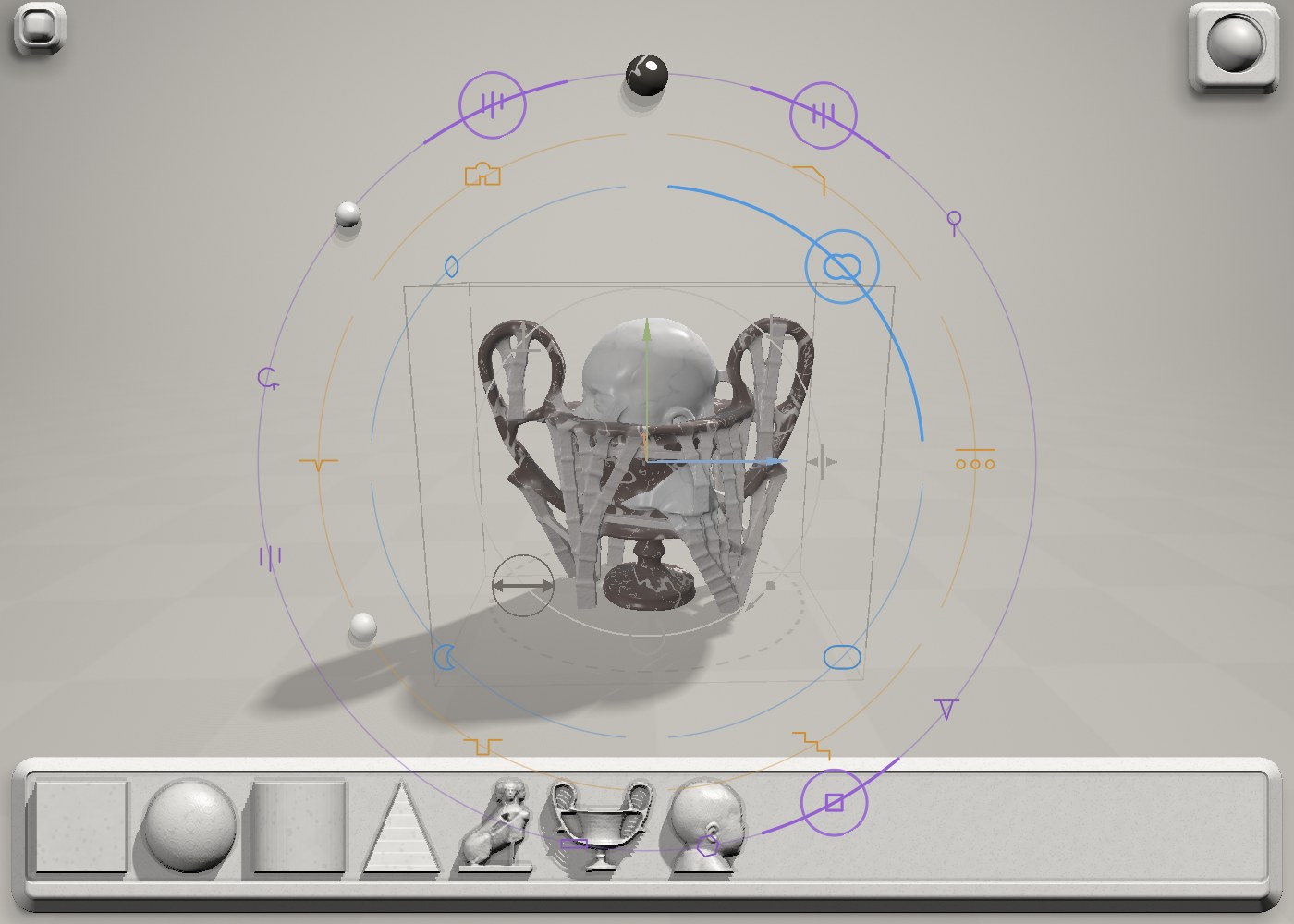
The shelf along the bottom holds the fragments and primitives available to place — scanned pieces from a library of more than eighty (vessels, heads, reliefs, animals, a sleeping Ariadne) alongside plain cube, sphere, cylinder, pyramid, and a four-headed form — each carved into the tray as a small relief plaque rather than an icon with a caption. You drag a piece up off the shelf into the scene; hold it instead and Spolia asks which way is up. Raw scans (.stl, .obj, .glb) dropped onto the window are baked into fragments right there in the browser.
Select a piece and it is ringed by a collar of three rings of small glyph-teeth. The blue ring sets how the piece combines with the rest (union, smooth union, subtract, intersect); the ochre ring cuts the joint where it meets them (chamfer, columns, stairs, groove, engrave, weld — slide sideways to widen, or to set the count); the violet ring grows and dresses its supports. A lit ball of the piece's own stone sits at the top — tap it to choose among the 28 materials, slide it to change the grain — and once there are two pieces a second ball sets one material for every joint in the composition: a lead line, a gilded seam.
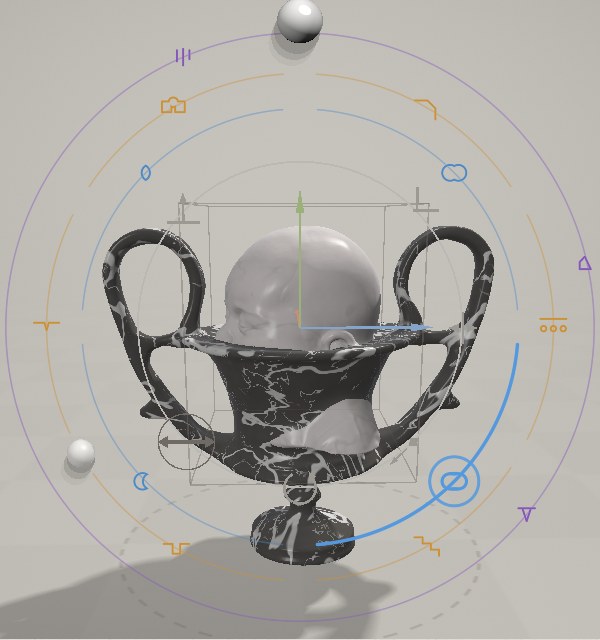
Inside the collar sits the manipulator — now a dial that always faces you, carrying six marks. Four choose a mode: move (three axis arrows), turn (a ring per axis plus a view ring, or a free trackball on the body), size (a corner cube to scale evenly, a block per axis to stretch), and flip (mirror along any axis, tap again to undo). Two are one-shot actions: apply, which folds a rotation into the stone so the handles stand square to the room again, and stand it back up, which returns the piece to its pose on the shelf. Tap the active mode again and the manipulator steps aside entirely, so a piece that fills the screen can still be orbited. Pieces set to cut show as thin blue boxes, with a small arrow between cutter and cut that swaps their order when tapped.
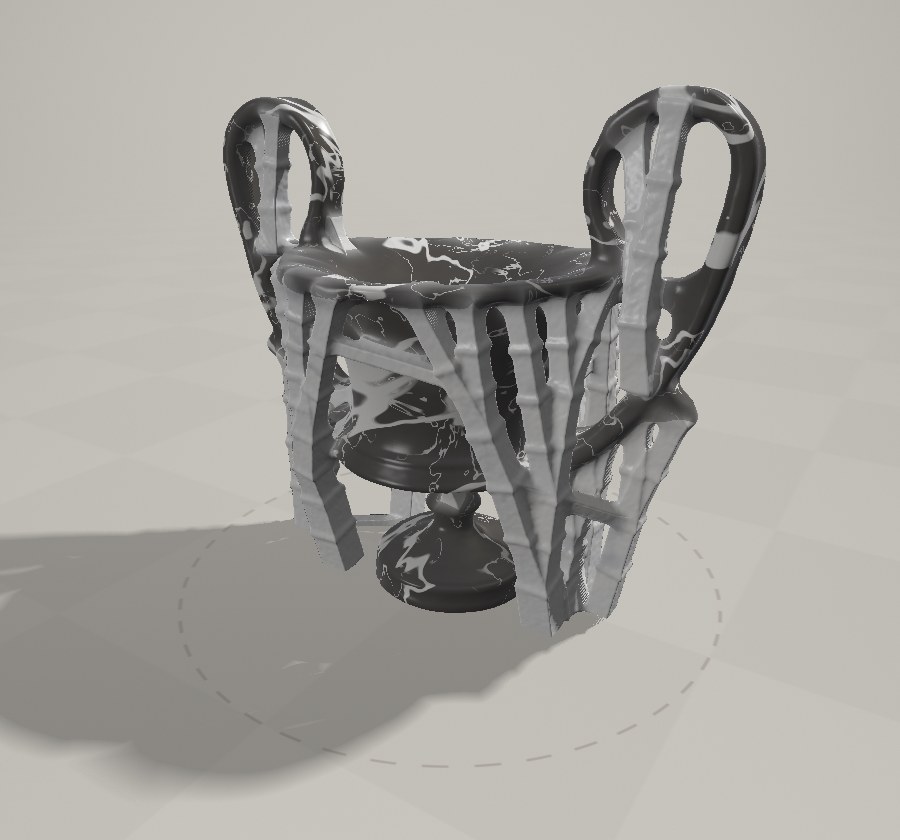
A piece also has to survive being printed. SPOLIA-Supports covers the overhang heatmap and the supports Spolia grows into the sculpture — struts that carry their own block material and are meant to be kept rather than snapped off, after the Roman habit of carving the puntello into the marble. They come in seven carvings — smooth, trunk, vine, pelt, cloth, strut and spiral strut — can anchor to the floor, to a wall behind the work, or both, and can carry an ornament: any fragment repeated along them.
Finished work leaves four ways: an STL for printing (40–300 mm), a GLB with the stone's colour, roughness and metal baked on, and two single-file web viewers to send to anyone — one that raymarches the real fields live, and one that carries the baked mesh and opens instantly on any phone. Or share a link to the arrangement itself.
- SPOLIA-UserGuide — every control, gesture and menu item.
- SPOLIA-Technical — how it works: the SDF atlases, the renderer, the materials, files and export.
- SPOLIA-Supports — growing supports, and the Roman argument for keeping them.
Lives in TROY/SPOLIA (index.html, one file, WebGL2, zero dependencies). Companion tools in the same folder bake raw scan meshes into the SDF atlases Spolia places (baker) and hold the fragment library (fragments). Live at https://auriea.art/spolia/.